Introduction
If you have been thinking about brightening your smile, you are not alone. Millions of people every year choose professional teeth whitening to remove stains and restore confidence in their appearance. But if you have never been through the process before, it is natural to wonder what actually happens during a teeth whitening procedure and whether it is right for you.
At Dentapex, we believe that informed patients make better decisions about their oral health. This guide walks you through everything you need to know about the professional teeth whitening procedure, from your first consultation to the final results, so there are no surprises in the chair.
What Is a Professional Teeth Whitening Procedure?
A professional teeth whitening procedure is a clinically supervised treatment that uses a high-concentration bleaching agent, usually hydrogen peroxide or carbamide peroxide, to break down stains on the enamel and dentine of your teeth. Unlike over-the-counter whitening strips or toothpastes, in-office whitening delivers faster, more consistent, and longer-lasting results because the concentration of the active ingredient is significantly higher and the process is carefully monitored by a trained dental professional.
The treatment targets two types of stains:
- Extrinsic stains that sit on the surface of the teeth, caused by coffee, tea, red wine, tobacco, and certain foods.
- Intrinsic stains that are deeper within the tooth structure, often caused by aging, medication, or fluorosis.
Professional whitening is most effective on extrinsic stains, though many patients see noticeable improvement in intrinsic discolouration as well.
Who Is a Good Candidate for Teeth Whitening?
Before recommending a teeth whitening procedure, a good dentist will assess your oral health to make sure the treatment is appropriate for you. You are likely a good candidate if:
- Your teeth and gums are generally healthy
- You have no untreated cavities or active gum disease
- You are not pregnant or breastfeeding
- Your staining is primarily on natural teeth rather than on crowns, veneers, or fillings
If you have dental restorations, it is important to know that whitening agents do not change the colour of crowns or composite bonding. Your dentist will discuss how to manage this so your smile looks even and natural after treatment.
Step-by-Step: What Happens During the Teeth Whitening Procedure
Step 1: Initial Consultation and Dental Examination
Every professional teeth whitening procedure begins with a thorough dental examination. At Dentapex, our dentists check for cavities, gum inflammation, cracks, or sensitivity issues that could affect your treatment or cause discomfort. This step is not just a formality. It protects your long-term oral health and ensures the whitening treatment will work effectively.
Your dentist will also take a shade measurement of your current tooth colour using a shade guide. This gives you a clear before-and-after comparison once the treatment is done.
Step 2: Professional Cleaning
For the whitening gel to work evenly, your teeth need to be free of plaque and tartar. Most clinics, including Dentapex, recommend a professional dental cleaning before the whitening session. This ensures the bleaching agent can make full contact with the tooth surface and reduces the risk of patchy results.
Step 3: Gum and Lip Protection
Once your teeth are clean and dry, the dentist will apply a protective barrier to your gums. This is usually a rubber dam or a gel that hardens under a UV light. A retractor is used to hold your lips and cheeks away from your teeth, keeping the whitening gel away from soft tissue and preventing irritation.
This step is one of the key differences between a professional in-office treatment and DIY kits. Proper tissue protection significantly reduces the risk of gum sensitivity or chemical burns.
Step 4: Application of the Whitening Gel
The dentist carefully applies the whitening gel, which contains hydrogen peroxide at concentrations typically between 25 and 40 percent, directly onto the front surface of your teeth. The gel is applied in a controlled, even manner to cover each tooth fully without touching the gums.
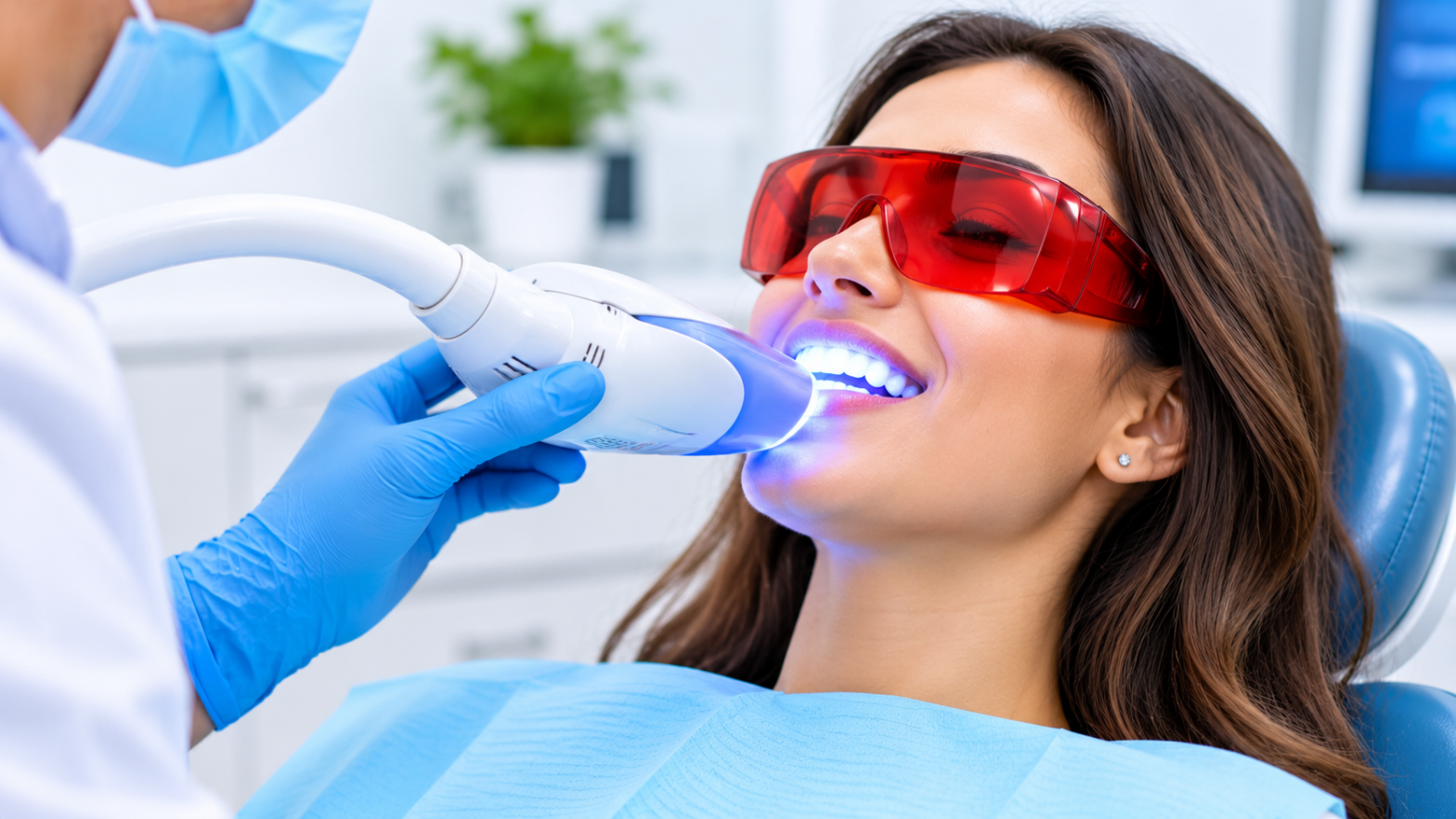
Depending on the system being used, a special LED curing light or laser may then be directed at your teeth to activate the whitening agent and speed up the chemical reaction. This light does not bleach the teeth on its own. It simply helps the hydrogen peroxide break down more quickly, releasing the oxygen molecules that lift stains from the enamel.
Step 5: Gel Removal and Reapplication
The gel is usually left on for 15 to 20 minutes, then removed and reapplied. Most in-office teeth whitening sessions involve two to three rounds of application during a single visit. Between each application, your dentist may check for sensitivity and adjust the treatment if needed.
The entire in-chair session typically takes between 60 and 90 minutes, depending on the system used and the degree of staining being treated.
Step 6: Rinse, Assess, and Compare
Once the final application is complete, the gel is rinsed off and the protective barriers are removed. Your dentist will then compare your new tooth shade against the original shade recorded at the start of the appointment.
Most patients achieve a result that is four to eight shades lighter in a single session. If you are aiming for a more dramatic change, your dentist may recommend a follow-up visit or a take-home whitening kit to maintain and build on your results.
What to Expect After the Teeth Whitening Procedure ?
Immediately after your in-office whitening treatment, your teeth may feel more sensitive than usual. This is completely normal and typically settles within 24 to 48 hours. The sensitivity happens because the whitening gel temporarily opens the pores of the enamel, making the teeth more reactive to temperature changes.
Here is what you should do in the 48 hours after your teeth whitening procedure:
- Avoid dark-coloured foods and drinks such as coffee, tea, red wine, berries, and tomato sauce
- Do not smoke or use tobacco products
- Use a sensitivity toothpaste if needed
- Stick to lukewarm water and bland, light-coloured foods
- Follow any aftercare instructions provided by your Dentapex dental team
This short window is called the white diet period, and following it properly helps protect your results while the enamel pores re-seal.
How Long Do Teeth Whitening Results Last?
The longevity of your results depends on your lifestyle and oral hygiene habits. On average, professional teeth whitening results last between six months and two years. Patients who avoid staining foods and drinks, do not smoke, and maintain a good brushing and flossing routine tend to enjoy longer-lasting brightness.
At Dentapex, we often recommend pairing your in-office treatment with a custom take-home whitening kit for top-up treatments. This combination approach gives you the best of both worlds: fast in-clinic results with the ability to maintain your smile at home over time.
In-Office Whitening vs Take-Home Whitening Kits
Both options are legitimate and effective, but they work differently and suit different needs.
In-office professional whitening delivers immediate, noticeable results in a single appointment. It is ideal if you have a wedding, job interview, or special event coming up. Take-home kits provided by your dentist use custom-fitted trays and a lower-concentration gel that you apply for 30 to 60 minutes a day over one to two weeks. The results are more gradual but still far superior to pharmacy whitening products.
Over-the-counter whitening strips and gels use much lower concentrations of bleaching agents and are not custom-fitted to your teeth. They can help with mild surface staining but are unlikely to deliver the kind of transformation that a professionally supervised teeth whitening procedure can achieve.
Is Teeth Whitening Safe?
When carried out by a qualified dental professional, teeth whitening is safe and well-tolerated by most patients. The key to safety is proper assessment, correct application, and appropriate aftercare. At Dentapex, every teeth whitening procedure is performed under the supervision of registered dentists who follow evidence-based protocols to protect your oral health.
Some patients experience temporary sensitivity or mild gum irritation, but these side effects are short-lived. Whitening does not damage enamel when done correctly, and there is no long-term risk to your teeth from professional treatment carried out at appropriate intervals.
Why Choose Professional Whitening at Dentapex?
At Dentapex, we combine clinical expertise with a patient-first approach. Our dentists take the time to understand your smile goals, assess your dental health, and design a whitening plan that suits your needs and budget. We use proven whitening systems, follow strict safety protocols, and are with you every step of the way, from your first consultation to your post-treatment follow-up.
We also know that every patient is different. Some people need a single in-office session. Others benefit from a combined approach. Our team will give you an honest recommendation based on your individual situation, never a one-size-fits-all solution.
Final Thoughts
A professional teeth whitening procedure is one of the simplest and most effective ways to improve your appearance and boost your self-confidence. With the right preparation, the right provider, and a little aftercare, you can walk out of the clinic with a visibly brighter smile in just one appointment.
If you are ready to find out whether teeth whitening is right for you, book a consultation with Dentapex today. Our team is here to answer your questions, assess your smile, and help you achieve the results you are looking for.